Is algo buying and selling worthwhile in the USA — that is one of the most searched questions among American investors and retail traders right now. Is algo trading profitable? This is exactly what many beginners want to understand before entering the market. Algorithmic trading has exploded in popularity throughout economic markets in the United States during the last decade. From Wall Street’s largest automated trading desks right down to man or woman buyers using their very own trading software at home, everyone wants to recognize if letting a system make trading selections can definitely position real money to your pocket.
The short solution is sure, it may be; however, the longer, more honest solution is that it depends on a whole lot of shifting components that most humans by no means talk about. This guide will guide you through everything you need to understand, in undeniable English, so that you can decide whether or not algorithmic trading is proper for you.
What Is Algorithmic Trading and How Does It Work in the USA?
Algorithmic trading involves the usage of a pc application — referred to as a set of buying and selling rules or an algorithmic trading engine — to robotically locate buy and sell orders in financial markets. Instead of a human sitting in front of a display screen watching charts all day, the buying and selling software does the trading across the clock. In America, algorithmic buying and selling is used by hedge funds, large financial institutions like banks, and man or woman retail traders. Platforms that include Angel One and numerous US-based brokers now provide access to algorithmic orders for everyday traders, not simply experts.
The machine reads market records feeds in real time, analyzes market microstructure, and executes trades based on a hard and fast of pre-programmed regulations. These guidelines may be simple, like shopping for when the 50-day Moving Average crosses above the 200-day Moving Average, or extraordinarily complex, regarding dozens of technical indicators, statistical models, and threat controls all working together. The execution velocity of an algorithmic buying and selling gadget is one of its largest advantages — it can react to market changes in milliseconds, something no human trader can ever do.
You can also read about how to calculate pips in forex.
Is algo trading profitable Make Money? Understanding the Real Potential
The question of whether algorithmic trading can make money is one that financial news outlets, traders, and researchers debate constantly. The truth is that many professionally run algorithmic trading strategies are highly profitable, especially those operated by large financial institutions with access to superior market data, low transaction costs, and advanced execution stacks. For retail traders in the USA, the picture is more complicated but still full of real opportunity.
Quantitative trading — the practice of using math, statistics, and data to build trading strategies — is at the core of most profitable algorithmic systems. Strategies like statistical arbitrage, market making, and momentum-based strategies, the use of equipment like the Moving Average Crossover, Bollinger Bands, the Golden Cross, and the Death Cross have all been shown to generate robust returns in the right marketplace situations. A Golden Cross takes place while a quick-time period moving average crosses above a protracted-term transferring common and is widely considered a bullish sign, while the Death Cross is the opposite and alerts potential drawback in advance.
High-frequency buying and selling, a specialized form of algo trading that executes thousands of trades consistent with 2nd, is ruled by way of big companies with direct connections to stock exchanges and huge generation budgets. For the common American retail dealer, competing at that degree is not practical. However, lower-frequency strategies that focus on daily or weekly signals can still be very effective and profitable when built and tested properly. Trading Xone covers these kinds of practical strategies in depth for traders at every experience level.
How Profitable Is Algorithmic Trading? What the Numbers Actually Say
Profitability in algorithmic trading is not a fixed number. It varies dramatically depending on the strategy being used, the quality of the backtesting process, the trading volume involved, and how well the risk management system has been designed. Studies on quantitative trading performance show that top-tier hedge funds running systematic strategies have delivered consistent annual returns ranging from 15% to over 60% in strong years, though these are exceptional cases reserved for firms with enormous resources.
For retail traders, honest expectations are important. Many beginners lose money in the first year because they skip proper backtesting quality checks or rely on overfitted strategies that look great on historical data but fall apart in live trading. The difference between a strategy that is successfully live traded and one that only looks good on paper usually comes down to how rigorously the system was tested, including using techniques like Monte Carlo resampling to stress-test performance across thousands of simulated market scenarios.
Execution friction — meaning the hidden costs that eat into profits like slippage, bid-ask spreads, and transaction costs — plays a major role in whether a strategy stays profitable once it goes live. A strategy that shows a 25% annual return in backtesting might deliver only 12% in reality once real-world execution costs are factored in. This is especially true for strategies that depend on high trading volumes and tight order-book dynamics.
Algorithmic Trading Benefits and Risks Every USA Trader Must Know
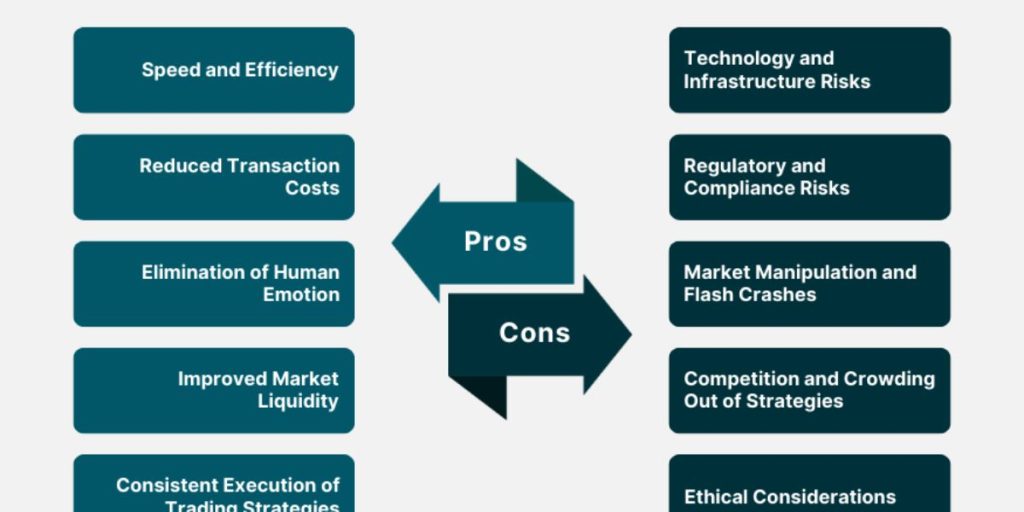
There are real and powerful algorithmic trading benefits that make it attractive to traders across the United States. First, emotion is removed from the equation entirely. Human traders panic, get greedy, and make irrational decisions under pressure. An algorithmic trading system follows its rules no matter what, which dramatically reduces emotional decision-making errors. Second, the system can monitor multiple markets simultaneously, far more than any human could manage. Third, trades are executed at the best available prices with extreme execution speed, improving market liquidity and reducing the negative impact of emotional reactions to price swings.
However, the risks are just as real and deserve serious attention. One of the biggest dangers is a technical glitch — a bug in the code that causes the system to execute wrong trades, take on an oversized position, or loop endlessly, flooding the market with erroneous algorithmic orders. This has happened to professional firms and caused massive financial losses within seconds. The 2010 Flash Crash, one of the most dramatic single-day events in US stock exchange history, was heavily influenced by automated systems responding to each other in a dangerous feedback loop that briefly wiped trillions of dollars from the market.
Over-optimization is another major risk that destroys many promising strategies. This is when a trading algorithm is tuned so precisely to past market data that it has no ability to adapt to new conditions. Proper risk and money management is therefore not optional — it is essential to survival. Every robust algorithmic trading system must include Stop-Loss Orders to limit downside on any single trade, Take-Profit Orders to lock in gains before the market reverses, and clear position sizing rules to ensure no single bad trade wipes out the account.
Is Algorithmic Trading Worth It? The Honest Assessment for American Traders
Whether algorithmic trading is worth it depends entirely on who is asking. For serious traders in the United States who are willing to invest time in learning programming, understanding market microstructure, and building a sound risk management system, the answer is a strong yes. The advantages of speed, consistency, and emotionless execution are difficult to replicate manually, and the ability to scale a proven strategy across multiple instruments and markets gives algo traders a genuine and lasting edge.
One exciting development in the USA trading community is the growth of funded account programs. Organizations like Goat Funded Trader and Quant League offer traders the chance to trade with firm capital once they pass a performance evaluation, removing the barrier of needing large personal capital to get started. These programs have opened the door for talented algo traders across the United States who have the skills but not the startup money. Being part of a community of traders through such programs also provides valuable feedback, accountability, and shared knowledge that can dramatically improve a trader’s algorithm over time.
Venue matching rules, which determine how and where orders are routed and matched at different stock exchanges and trading venues in the USA, also matter deeply to overall profitability. Understanding how order routing affects fill quality is a part of execution strategy that many retail traders overlook, but professional traders treat as a core discipline. The best trading platforms in the US give traders control over these settings and full transparency into how their algorithmic orders are being handled in real time.
Building a Profitable Algorithmic Trading Strategy in the USA
Building a worthwhile set of buying and selling rules begins with clear buying and selling dreams. Before writing a single line of code, you want to outline what you want to achieve — your goal return, your most suitable drawdown, your selected marketplace, whether that is shares, futures, forex, or crypto, and your supposed conserving length. These goals form each choice that follows, from the technical indicators you choose for your hazard controls and how aggressively you lengthen your positions in live marketplace situations.
Once your desires are clear, the subsequent step is approach development. Common processes include fashion-following strategies that use indicators like the Moving Average Crossover and Bollinger Bands to pick out directional momentum, imply reversion strategies that wager on costs returning to their mean after a massive fluctuation, and market-making techniques that benefit from offering market liquidity by means of setting limit orders on all facets of the book. Each approach has its own strengths and weaknesses, relying on modern market conditions and buying and selling extent levels.
After the strategy is coded, rigorous backtesting quality becomes everything. Running a backtest approach, checking out your approach on historical market data to see how it’d have performed in the past. But a basic backtest is never enough on its own. Smart traders in the USA use Monte Carlo resampling to create thousands of randomized versions of the historical data, helping them understand the full range of possible outcomes and avoid mistaking one good backtest for a guaranteed winning system. Strategies should also always be tested on out-of-sample data — meaning data that was never used during the strategy development process — before being deployed with real capital.
Trading Xone regularly publishes detailed guides on backtesting methods, risk management frameworks, and real-world case studies to help traders avoid the most common and costly mistakes at every stage of algorithm development.
You can also read about eurusd market analysis for February 2026.
The Role of Technology and Market Stability in US Algo Trading
Technology is the backbone of every algorithmic trading system, and in the United States, the quality of available technology is world-class. From cloud-based trading platforms with built-in algorithmic order management, to co-location services that allow traders to place their servers physically close to stock exchange data centers for the fastest possible execution speed, the infrastructure available to US traders is truly unmatched anywhere in the world.
Market data feeds are the lifeblood of any algo trading system. Without accurate, low-latency data, even the best trading algorithm will make poor decisions at critical moments. Top-tier market data providers in the USA deliver tick-by-tick price data across all major asset classes, and many also offer alternative data, including social media sentiment, options flow, and order flow analytics that can give a well-designed trading strategy a meaningful informational edge over the broader market.
Market balance — the overall predictability and orderliness of US monetary markets — is commonly excessive in comparison to different countries, which is one reason America remains the most attractive destination for both men and women and institutional algorithm buyers internationally. The Securities and Exchange Commission and the Financial Industry Regulatory Authority have put in place clean policies around algorithmic trading to reduce systemic risk and defend market balance, and any severe algorithmic dealer inside the USA needs to be absolutely familiar with these policies to function legally and responsibly.
Conclusion
Algorithmic trading can virtually be profitable inside the United States; however, it is not an assured shortcut to riches. The investors who constantly make cash with algo trading are folks who take it seriously — they invest time in learning, they check their strategies carefully using methods like Monte Carlo resampling, they manipulate threat intelligently with Stop-Loss Orders and sound risk and money control regulations, and they live disciplined when the marketplace behaves unexpectedly. They understand execution friction, respect the impact of transaction costs, and continuously refine their systems based on live trading results.
For those inclined to take a position in the effort, algorithmic trading provides an effective and scalable manner to participate in the US economic markets. Whether you’re constructing your very own gadget from scratch, joining a funded trader program through corporations like Goat Funded Trader or Quant League, or gaining knowledge through a sturdy community of investors, the path to worthwhile algo buying and selling may be very real. It requires work, staying power, and highbrow rigor; however, for people who embrace that undertaking, the rewards in the international’s most liquid and dynamic monetary market may be actually existence-converting.
Frequently Asked Questions
Is algorithmic buying and selling a prison for retail traders in the USA?
Yes, algorithmic trading is absolutely felony for retail traders inside the USA as long as you observe SEC and FINRA guidelines and trade through an authorized brokerage or trading platform.
How much money do I need to start algo trading in the USA?
You can start with as little as a few hundred dollars on many platforms, though funded account programs like Goat Funded Trader let you trade firm capital after passing their evaluation, removing the need for large personal savings.
What is the largest hazard in algorithmic buying and selling?
The biggest risks consist of technical glitches in the code, negative backtesting performance, over-optimization of techniques, and failure to implement the right risk controls, like Stop-Loss Orders and disciplined function sizing.
Can beginners examine algorithmic buying and selling and make it profitable?
Yes, beginners can without a doubt learn and take advantage of algorithmic buying and selling with the aid of starting with simple techniques, studying risk management thoroughly, and the use of communities like Quant League to sharpen their skills over the years.