Algo trading vs quant trading for and promoting, for and selling. In the USA, financial markets are one of the freshest subjects amongst traders and buyers right now. Before we dive into the variations, let us begin by using our expertise to understand what algorithmic buying and selling is in simple terms.
Algorithmic purchasing for and promoting, also called algo shopping for and promoting, is the approach of the usage of pc software or a buying and selling bot to automatically buy and sell financial assets based on a set of rules. Think of it like giving a robot a checklist and letting it act on your behalf without you lifting a finger. These regulations can be as smooth as “buy this inventory while its rate drops beneath $50 and sell it while it climbs again above $60.”
In the USA, algorithmic trading is everywhere. Major monetary establishments, funding banks, and hedge funds on Wall Street depend closely on automated buying and selling systems each single day. A massive portion of the everyday trading volumes on the New York Stock Exchange and NASDAQ is driven by using algorithms running on effective computer systems. The velocity of these systems is, in reality thoughts-blowing. They can execute hundreds of trades in fractions of a second, something no human trader may want to ever physically do on their own.
The largest advantage of algorithmic buying and selling is consistency. A well-built trading algorithm does not panic during a sudden market crash. It does not get greedy when prices are shooting up. It does not make emotional decisions at three in the morning. It simply follows its trading logic, around the clock, every single day. This makes algo buying and selling extraordinarily beneficial for techniques like market making, statistical arbitrage, and high-frequency buying and selling, all of which require lightning-fast and particular execution.
Common algorithmic trading strategies used throughout the US markets consist of fashion-following structures, implied reversion strategies, and arbitrage plays. Many retail traders across the USA also use simpler forms of algorithmic trading through various algorithmic trading platforms that let them set up automated rules based on technical indicators like moving averages or the Relative Strength Index.]
You can also read about the best indicator for gold trading.
So What Is Quant Trading, Then?
Quantitative buying and selling, or quant trading, goes several steps deeper than algorithmic buying and selling. It is a facts-driven buying and selling technique that uses mathematical fashions, statistical techniques, and massive datasets to become aware of possibilities within the economic markets. A quant trader, frequently in reality known as a quant, typically has a sturdy background in mathematics, statistics, computer technology, or engineering.
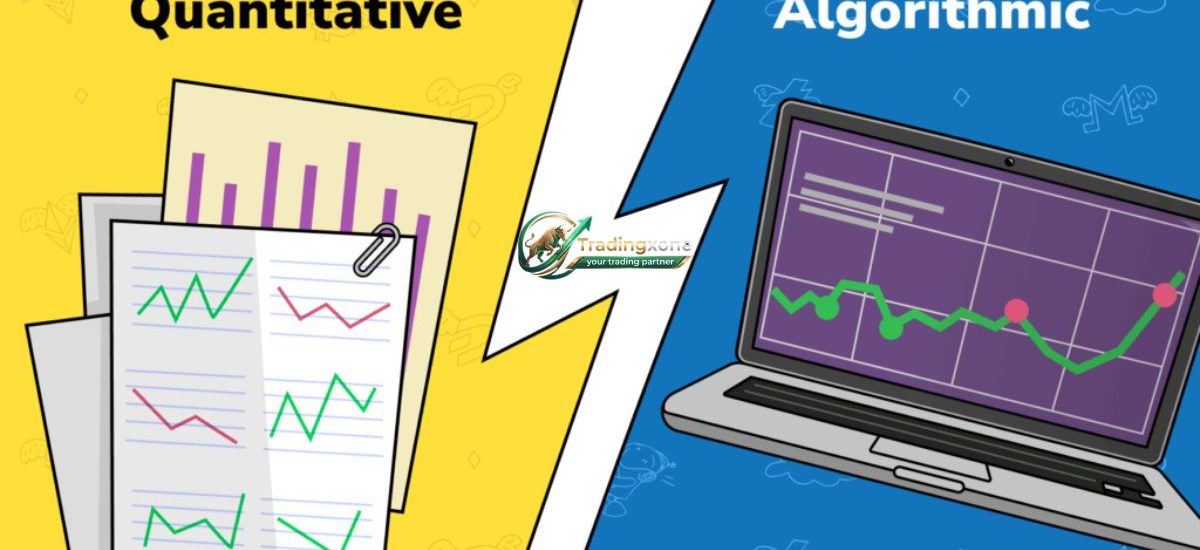
While algo trading focuses especially on automating the execution of trades, quant trading specializes in constructing the underlying models that try to are expecting wherein fees are going to move subsequently. In other words, quant buying and selling is ready with the technology and the studies behind the approach, even as algo trading is ready to put that approach into real movement. You ought to think of quants as the architects of a building and algo buyers as the development group that definitely builds it.
In the United States, quant trading is dominated by using elite firms like Renaissance Technologies, Two Sigma, and D.E. Shaw. These agencies employ a number of the most amazing mathematical minds in the world. They examine sizeable amounts of real-time market records, looking for styles and market inefficiencies that can yield consistent profits. Their quant trading models are closely guarded secrets worth billions of greenbacks
Quant investors use advanced equipment like regression analysis, system gaining knowledge of, and time series modeling to construct their techniques. They examine everything from charge movements and buying and selling volumes to economic signs and even social media sentiment. The intention is usually the same — discover a reliable, repeatable side in the market that can be systematically exploited over the years the use of records-pushed buying and selling strategies.
Algo Trading vs Quant Trading — The Real Difference Explained Simply
The heart of the difference between algo trading and quant trading comes down to what each one is actually focused on. Algo trading is primarily concerned with the automation and speed of trade execution. It is about turning any strategy — whether simple or complex — into an automated system that runs on its own without human input. Quant trading, on the other hand, is focused on the deep research and development of trading strategies using statistical models and serious mathematical analysis.
Here is an easy real-world example to make this crystal clear. Imagine a quant researcher operating at a trading firm in Chicago. She spends months studying actual-time marketplace data, constructing quant buying and selling fashions, and checking out one-of-a-kind information-pushed trading strategies to discover an facet that works. Once she is confident her strategy holds up, she hands it over to the algo trading team. They then code her strategy into a full algorithmic trading system that can execute trades in live trading, sometimes thousands of times per second.
So quant trading is the brain, and algo trading is the muscle. Both are necessary, and in most professional environments, they overlap a great deal. Many quant traders also build their own algorithmic trading platforms, and many algo traders use quantitative research to make their strategies sharper. The line between the 2 is frequently blurry in exercise, in particular at large automated trading desks in New York or other primary US monetary centers.
For novices, knowing this distinction subjects loads as it tells you precisely what competencies and equipment you want to focus on. If you need to get into algo trading, begin by gaining knowledge of coding languages like Python, recognizing how buying and selling platforms and APIs work, and getting snug backtesting your thoughts. If quant buying and selling is your aim, you want a deeper foundation in arithmetic, statistics, and financial theory on top of your coding capabilities.
How These Approaches Are Shaping Financial Markets Across the USA
The United States is home to some of the most energetic and liquid monetary markets within the whole world, which makes it a great environment for algorithmic buying and selling and quantitative buying and selling to thrive. Cities like New York, Chicago, Boston, and San Francisco are packed with buying and selling firms, hedge funds, and independent buyers deploying sophisticated automated and information-driven strategies every single trading day.
In New York, huge funding banks and hedge funds use algorithmic trading structures for the entirety, from fairness buying and selling to constant income and derivatives. On the Chicago Mercantile Exchange, high-frequency trading corporations rely upon low-latency trading systems to execute heaps of trades consistent with 2d in the futures markets. In San Francisco and throughout Silicon Valley, tech-savvy quant companies blend synthetic intelligence with financial modeling to expand the subsequent technology of buying and selling algorithms.
Retail investors across the US have additionally received meaningful access to to algo buying and selling gear through systems like Interactive Brokers and TradeStation, which permit individual customers to develop their personal trading algorithms and run them on live accounts. This has opened the door for normal buyers who want to move beyond discretionary trading and into extra systematic, guidelines-based techniques that get rid of emotion from the equation completely.
Understanding market microstructure, marketplace liquidity, and the way market information feeds work is vital for everybody running in this area, whether or not at a large institutional level or as a man or woman dealer running from home
Which One Is Better for You — Algo Trading or Quant Trading?
This is the question each beginner asks, and the honest solution is that it virtually relies upon your heritage, your desires, and what sort of time you are inclined to invest in mastering. For most normal investors and buyers inside the USA, algo trading is the extra on hand and sensible place to begin. You can start with an easy method, automate it with the use of buying and selling software programs, and steadily refine your approach as your competencies and confidence develop over the years.
If you have a robust mathematical or scientific history and a real passion for digging into facts, quant trading might be the more rewarding route for you. It demands more upfront funding in learning and building capabilities, and the rewards are full-size. Quants are among the highest-paid experts inside the entire US finance industry, with many at top firms incomes well into seven-digit compensation packages every yr.
It is also well worth pointing out that quant buying and selling and algo trading are not collectively exceptional choices. Many of the most successful traders in the USA combine elements of both approaches. They use quantitative studies and statistical methods to identify worthwhile techniques and then construct algorithmic systems to execute those strategies effectively in live markets. This mixed approach is well-known at hedge funds and proprietary trading companies in which teams of quants and programmers collaborate intently at the computerized trading table each day.
Resources like Trading Xone offer the sort of plain-language schooling that enables investors at every degree to cut through the complexity and start understanding those topics in a sensible, actionable manner.
The Critical Role of Technology and Market Data
Both algorithmic trading and quant trading are deeply dependent on technology and high-quality market data. In the US, firms spend impressive amounts of money on buying and selling infrastructure, co-place offerings, and real-time marketplace statistics feeds simply to benefit the smallest possible part over their competition. This is especially relevant for high-frequency buying and selling corporations, where being only a few milliseconds quicker than a rival can mean the distinction among reserving a profit and taking a loss
For quant buyers, getting right of entry to easy, accurate, and comprehensive historical marketplace data is honestly critical. Without dependable statistics, even the most splendid statistical version will produce unreliable and mistaken outcomes. Many top quant firms in the USA maintain their own private databases of market data collected and cleaned over many years. This proprietary data gives them a real and lasting advantage in building and stress-testing their quant trading models.
Technology also plays a big role in dealing with market effects and maintaining market balance. When a huge algorithmic buying and selling device places a giant order within the market, it must accomplish that in a way that doesn’t circulate the marketplace against itself and drive up its own expenses. This is where understanding market microstructure, market reactions, and market liquidity becomes significantly important for running a successful and sustainable algorithmic buying and selling operation over the long time.
You can also read about a leveraged bitcoin short position.
Conclusion
Understanding the difference between algo trading and quant trading in the USA is not just an academic exercise. It is certainly a realistic step toward becoming a wiser and more assured participant in present-day financial markets. Algo trading offers you the energy to automate your strategies and exchange at device speed without emotional interference getting in the way. Quant buying and selling offers you the scientific tools and statistical strategies to discover and validate records-driven techniques that could produce regular outcomes over the years.
Both processes are actively shaping the destiny of trading throughout the United States, from the large buying and selling floors of New York and Chicago to the home offices of unbiased retail investors constructing their first buying and selling bot. The financial markets have usually rewarded individuals who are prepared, disciplined, and willing to adapt as conditions change. Whether you pick out the algo path, the quant path, or a smart combination of both, the maximum vital step you could take right now could be to keep studying, keep trying out, and keep improving your approach every single day.
Frequently Asked Questions
Is quant trading different from algo trading?
Yes, quant trading is focused on constructing mathematical fashions and finding facts-driven market edges, even as algo buying and selling is focused on automating change execution.
Is algo trading a 100% profitable?
No, algorithm buying and selling isn’t guaranteed to be worthwhile. Like any buying and selling technique, it entails chance, and techniques can forestall working whilst marketplace conditions shift, which is why continuous checking out and refinement are important.
What are the 4 types of trading?
The four foremost kinds are day trading, swing buying and selling, role buying and selling, and scalping. Algorithmic and quantitative methods may be implemented efficaciously for all four processes, depending on the approach.
Can quants make 7 figures?
Yes, top quant traders and researchers at elite US firms can absolutely earn seven-figure salaries and bonuses, though this typically requires advanced degrees, exceptional mathematical ability, and a strong track record of real results in live trading.