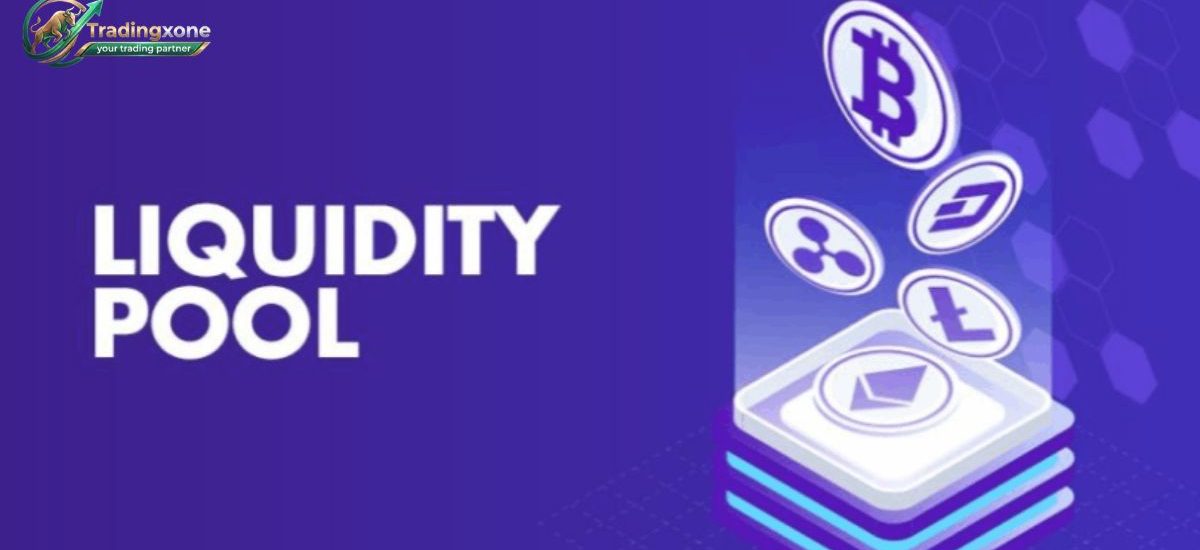
Liquidity pools in trading USA have completely changed the way human beings purchase and promote crypto assets, and when you have been looking the DeFi environment grow during the last few years, you recognize how effective this shift has been.
Whether you’re a retail trader sitting in New York, a DeFi enthusiast in Texas, or someone just getting started out in California, knowledge how liquidity swimming pools work in buying and selling is one of the maximum vital matters you may do for your financial schooling in 2024 and beyond. This guide breaks the entirety down in plain, normal language so that all of us can observe along, no advanced finance diploma required.
You can also read about spot trading explained.
What Exactly Is a Liquidity Pool and Why Does It Matter?
A liquidity pool is basically a large pile of two or extra crypto belongings locked inner a smart agreement on a decentralized alternate. Instead of needing a buyer and a supplier to be to be had at exactly the same moment like on conventional centralized exchanges, the pool itself acts because the counterparty to each trade. This is what makes decentralized finance so fundamentally one-of-a-kind from the old manner of doing things.
In the conventional monetary international, market makers have been huge institutions or expert investors who constantly positioned buy and sell orders into order books to hold markets transferring. If you desired to promote Bitcoin on a centralized alternate within the USA, a person on the opposite aspect had to be willing to buy it right then and there. But with a liquidity pool, none of that waiting is necessary.
The smart contract handles every token swap automatically using a formula called the Constant Product Market Maker, which keeps the math balanced no matter how large or small the trade is. This computerized market-making technique has quietly grow to be the backbone of the complete DeFi environment in the United States and beyond.
At Trading Xone, we cowl topics like this regularly due to the fact knowledge the core mechanics of the way liquidity swimming pools work in buying and selling is the foundation for the whole thing else in DeFi markets — from yield farming and liquidity mining to lending protocols and artificial property.
How Liquidity Pools Work in Trading: The Simple Breakdown
When someone wants to provide liquidity to a pool, they deposit an equal value of two tokens — for example, ETH and USDC — into a smart contract. In return, they receive LP tokens, also called liquidity pool tokens, that represent their share of the pool. These LP tokens are your proof of ownership, and you can use them later to withdraw your funds along with any trading fees that were collected while your assets were sitting in the pool.
Every time a trader swaps one token for another inside the pool, the AMM algorithm adjusts the prices automatically based on how much of each token remains. The more of one token that gets bought, the more expensive it becomes. This is price slippage happening in real time. If someone is making a very large trade on a pool that does not have a lot of total value locked, they might end up paying significantly more than the market rate because their own trade is moving the price against them.
This is why market depth matters so much in the DeFi ecosystem. Bigger pools with more total value locked mean better execution quality and lower price slippage for everyone involved. Platforms like Uniswap and Curve on Ethereum, as well as Trader Joe on Avalanche and Maverick Protocol, have grown their liquidity pools to billions of dollars to serve the growing demand from retail traders and institutions across the USA. The liquidity book model and newer onchain liquidity provisioning systems have also made it possible for liquidity providers to concentrate their funds within specific price ranges, making the whole system far more capital efficient than it used to be.
Liquidity Pool vs Traditional Trading Liquidity: What Is the Real Difference?
When traders talk about liquidity pool vs traditional trading liquidity, the conversation usually comes down to where the money sits and who controls it. On centralized exchanges like Coinbase or Kraken, both very popular among USA traders, liquidity comes from professional market makers who post bids and asks into order books. These are Tier-1 liquidity providers who take on risk in exchange for collecting the bid-ask spread. The exchange itself acts as a middleman holding your funds at all times.
On a decentralized exchange, the liquidity comes from regular everyday people. Anyone with crypto assets can become a liquidity provider, deposit funds into a pool, and start earning trading fees without asking anyone for permission. There is no middleman holding your money because the smart contract handles everything automatically. This is a massive shift in how financial power is distributed, and it is one of the biggest ideas behind decentralised finance as a whole.
Traditional order book DEXs and oracle-based DEXs try to combine the best features from both worlds, using real-time price feeds and order flow analysis to give traders better prices and lower gas fees. Tools like volume profile tools and liquidity heatmaps also help traders understand where big money is positioned, identify swing highs and consolidation zones, and track External Range Liquidity and Internal Range Liquidity, which are concepts borrowed from institutional trading strategies. The COVID-19 Market Crash in 2020 was one of the clearest examples of how traditional markets can seize up during a flash crash when liquidity disappears from order books almost instantly, while DeFi pools continued to operate without interruption.
The Benefits of Liquidity Pools for Traders in the USA
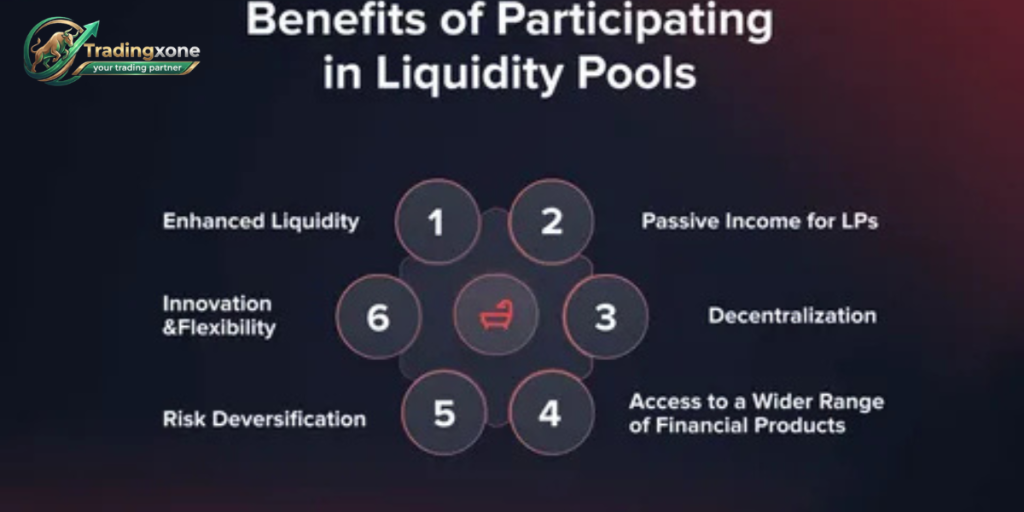
The benefits of liquidity swimming pools for traders are actual and measurable, specially for humans throughout america who are searching out new methods to place their crypto belongings to paintings. First and most manifestly, liquidity pools permit all and sundry to earn passive earnings through actually depositing belongings and accumulating a percentage of the trading expenses generated through the pool. On high-quantity platforms, this may upload as much as a significant go back through the years, mainly while combined with liquidity mining applications that reward carriers with extra crypto rewards or governance tokens on pinnacle of widespread expenses.
Second, liquidity pools offer access to a much wider range of trading pairs than most centralized exchanges can provide. In the DeFi ecosystem, new projects and tokens can create their own liquidity pools almost immediately after launch, giving early traders in the USA access to assets that might not be listed anywhere else yet. This is especially relevant given that regulatory compliance requirements can slow down how quickly new tokens get listed on traditional platforms in the United States.
Third, the AMM algorithms utilized by decentralised exchanges take away a few of the styles of market manipulation that may plague centralized markets. There are no darkish swimming pools hiding massive institutional orders, no hidden order books, and no capability for a single entity to secretly dominate the market. Everything that takes place on a blockchain is visible and verifiable via all and sundry with an internet connection, which creates a degree of market visibility that conventional finance truly can’t in shape. Slippage control gear, the liquidity book version, and advanced AMM algorithms have all stepped forward notably, making the experience better for both liquidity carriers and investors on decentralised exchanges.
The Risks Every Trader Should Understand Before Getting In
No honest conversation about liquidity pools in crypto trading is complete without talking about the risks involved. The most well-known risk for liquidity providers is impermanent loss. This happens when the price of the tokens in a pool shifts significantly from where they were when you first deposited them. The math of the constant product formula means that as prices change, the ratio of your two tokens automatically adjusts, and you can end up with less total value than if you had simply held the tokens in your wallet and done nothing at all.
Smart contract vulnerabilities are another serious concern that every USA trader should take seriously. Because every transaction in a DeFi liquidity pool is completed robotically via code, a trojan horse in that code may have catastrophic effects with no manner to reverse it. There have been foremost incidents in which hundreds of millions of dollars had been tired from swimming pools because of smart settlement bugs earlier than all and sundry ought to interfere. This is why many serious DeFi individuals spend money on insurance towards clever contract danger and select structures that have undergone thorough safety audits performed by way of legitimate corporations.
Rug pulls are also a persistent threat across the DeFi world. This is when the founders of a new project add liquidity to a pool, attract investors, and then suddenly remove all the funds, leaving everyone else holding worthless tokens. While security practices have improved and blockchain analytics companies have gotten better at identifying suspicious patterns, rug pulls still happen, particularly with newer NFT projects and unaudited token launches. For retail traders in the USA operating without the same protections that centralized exchanges offer, personal risk management and careful due diligence are absolutely essential.
How USA Traders Are Navigating the DeFi Ecosystem Today
Across the United States, a growing number of traders are getting comfortable with using decentralised exchanges and contributing to onchain liquidity provisioning platforms. Cities like San Francisco, Miami, New York, and Austin have become major centers of crypto and DeFi activity, with communities of developers, investors, and traders all working to make the most of this rapidly changing market structure.
Many institutional players are also starting to discover DeFi markets in the USA, attracted with the aid of the yield farming opportunities and the potential to earn returns on property that might otherwise sit down idle. With institutional interest developing step by step, the full value locked across major DeFi protocols has surged, which in flip improves market depth and reduces rate slippage for anybody who participates. At the equal time, regulators including the Securities and Exchange Commission are paying nearer interest to how liquidity pools and DeFi structures operate, signaling that regulatory compliance will become an increasingly more essential thing within the years beforehand.
Smart traders are already using market profile analysis, order flow analysis, and even liquidity heatmaps to identify where liquidity is sitting on-chain, spot potential rejection rates before entering trades, and build a clearer picture of DeFi market structure. Trading Xone continues to track these developments closely, because staying ahead of the curve in the DeFi ecosystem is what separates successful traders from everyone else.
You can also read about perp vs spot trading
Conclusion
Liquidity pools in trading USA represent one of the most genuinely new ideas in financial markets in decades. By replacing conventional order books with automated marketplace makers and clever contracts, decentralised finance has opened up marketplace making to anybody with a crypto pockets, created completely new approaches to earn passive income via liquidity provision, and built a financial machine that runs across the clock without any imperative authority on top of things.
From the fundamentals of how liquidity pools work in trading to the subtleties of impermanent loss, AMM algorithms, and smart settlement vulnerabilities, there’s a excellent deal to study, but the rewards for doing so are very real.
Whether you are comparing a liquidity pool vs traditional trading liquidity, exploring the benefits of liquidity pools for traders, or trying to understand liquidity pools in crypto trading for the very first time, the core message remains the same: this technology is here to stay, it is growing fast, and the USA is right at the center of it all.
Frequently Asked Questions
What is a liquidity pool in simple terms?
A liquidity pool is a collection of or extra crypto tokens locked in a smart agreement that lets in investors to swap property without having a traditional consumer or vendor on the alternative facet.
How do liquidity providers make money from a liquidity pool?
Liquidity vendors earn a proportion of the buying and selling expenses generated every time a person makes a swap within the pool, and they’ll additionally get hold of extra crypto rewards via liquidity mining programs.
What is impermanent loss and should I be worried about it?
Impermanent loss happens whilst the fee of your deposited tokens modifications significantly once you add them to a pool, probably leaving you with less cost than sincerely holding the tokens would have; it’s miles a real risk however can be offset by using robust price income in excessive-quantity pools.
Are liquidity pools safe for traders in the USA?
Liquidity pools carry actual risks which include smart agreement bugs and rug pulls, so it’s miles important to apply structures that have completed thorough safety audits and to in no way deposit extra cash than you may have the funds for to lose.