Perp vs Spot Trading USA is one of the most searched topics among American crypto traders today, and for very good reason. The cryptocurrency markets have grown into a fast-moving, complex world where knowing your tools is the difference between building a strong crypto portfolio and watching your money disappear.
Whether you are brand new to trading or you have been in the crypto market for years, understanding exactly how spot trading and perpetual futures trading work — and how they differ from each other — is some of the most important knowledge you can have right now. This guide breaks everything down in plain, simple language so that any trader in the United States can walk away with a clear picture of both products, how they work, and which one belongs in their life.
The regulatory landscape in the USA is also shifting fast. Bodies, just like the Securities and Exchange Commission and the Commodity Futures Trading Commission, are pushing for more regulatory readability and stronger regulatory oversight of cryptocurrency markets. This makes it even more important for each crypto dealer in the USA. To recognize what they’re virtually buying and selling earlier than they positioned a unmarried dollar on the road.
What Is Spot Trading and How Does It Actually Work?
Spot trading is the most straightforward form of trading that exists in any financial market. When you purchase or promote a crypto asset immediately on the marketplace, you are exchanging actual money for the real digital asset on the cutting-edge spot rate — the live marketplace rate at the exact second your order is filled via the matching engine. Think of it exactly like taking walks into a shop, selecting something off a shelf, and deciding to buy it immediately. You own it the second the deal is done.
You can also read about algo trading companies.
If you buy Bitcoin through a spot trade on one of the major centralized exchanges in the USA, you now own real Bitcoin. You can move it into your digital wallets, hold it in a custody integration service, or transfer it wherever you like. There are no contracts, no expiry dates, and no borrowed funds required unless you choose to add margin on your own. Your maximum possible loss is simply what you paid. That kind of simplicity is extremely appealing, especially for anyone new to the crypto market.
Trading fees on spot markets are typically clean and easy to understand. Most platforms use a Maker/taker trading fees structure where traders who add liquidity to the order book — the makers — pay a slightly lower fee than those who take liquidity away, known as takers. Order book depth, trade execution speed, and the quality of the matching engine all play a role in how good your spot trading experience will be on any given platform.
The concept of spot Bitcoin became especially significant in the United States when spot Bitcoin ETFs entered the conversation, bringing the idea of owning real digital assets into mainstream American investment discussions. For long-term holders who want straightforward exposure to a crypto asset without any added complexity, spot trading remains the cleanest option available. Spot traders tend to be patient, long-term thinkers who are comfortable holding through market movements rather than chasing short-term price swings.
What Is Perpetual Futures Trading and Why Does It Work Differently?
Perpetual futures trading — commonly called perp trading — is a completely different animal. A perpetual futures contract is a derivative contract, meaning it is a synthetic contract that tracks the price of a crypto asset without you ever actually owning that asset. You are not buying Bitcoin. You are buying a contract that moves in value as Bitcoin moves in price. The single most important feature of a perpetual futures contract compared to Traditional Futures offered at institutions like the CME Group is that it never expires. There is no settlement date. You can hold a perp position for as long as you want, as long as your account has enough margin collateral to keep it open.
This is where the funding rate mechanism becomes critical to understand. Because perpetual futures have no expiry date, cryptocurrency markets use a funding rate system to keep the price of the perp contract closely aligned with the actual spot price of the underlying asset. Funding rates are periodic payments that flow between traders on opposite sides of the market.
When market sentiment is strongly bullish, and the perp price climbs above the index price, traders who are long pay traders who are short. When the market is bearish, and the perp price falls below the index price, the payment flows the other way. Watching funding rate indicators is an essential skill for anyone serious about Perpetual Futures Trading, because consistently high funding rates can quietly eat away at your profits even when your directional call is correct.
Platforms like Binance Futures and Bybit Earn have made perp trading accessible to traders around the world. American traders, however, operate in a more restricted environment due to regulatory oversight from U.S. agencies. Some traders attempt to access these offshore platforms through offshore trading arrangements, but this comes with real legal and financial risks that every U.S. based crypto trader needs to understand before going that route.
The Real Difference Between Perpetual Futures and Spot Trading
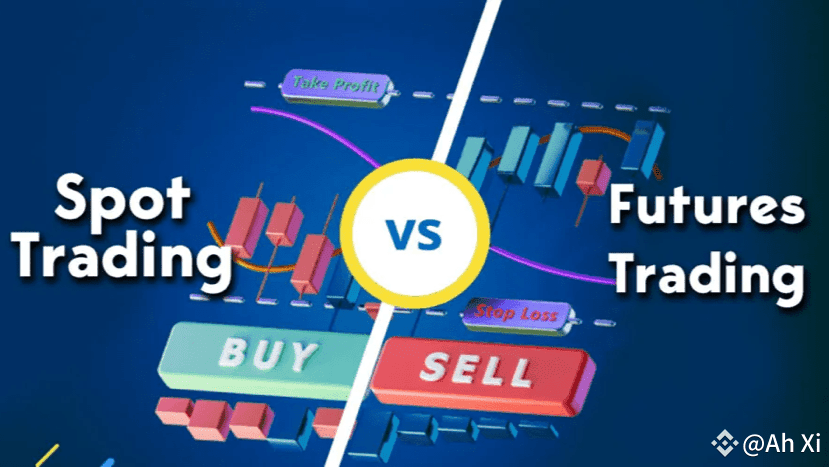
The difference between perpetual futures and spot trading comes down to three things: ownership, leverage, and risk. In spot trading, you own the actual asset. In perp trading, you own a contract. When you look at perpetual futures vs spot market crypto side by side, the contrast becomes very clear very fast. Spot is buy-and-own: you pay the market price, you receive the asset, and you can withdraw it anytime. Perpetual Futures Trading is margin-based: you open a leveraged position backed by margin collateral, and the exchange’s risk engine watches your position in real time to make sure you have enough funds to keep it open.
Understanding spot trading vs derivatives trading crypto also means understanding what happens when things go wrong. In spot trading, your asset loses value, but you still own it. You can hold through the pain and wait for recovery. In perp trading, if the market moves sharply against your position, you face a Margin Call and potentially a full liquidation.
The liquidation engine on most exchanges is completely automated. When your account balance falls below your liquidation levels, your position is closed without warning and without mercy. Liquidation cascades — situations where thousands of traders get liquidated at the same moment — can trigger enormous spikes in market volatility and send prices moving in dramatic, sudden ways. Liquidation bots actively hunt these liquidation-driven moves, making the perp market a much more intense environment than spot at its most volatile.
How Perp Trading Works vs Spot Trading — The Mechanics Made Simple
Understanding how perp trading works vs spot trading requires a look at what happens the moment you place a trade. In both cases, your order enters an order book and gets matched by a matching engine. The order flow from both spot and perp markets contributes to the overall crypto trading volume that gives us a picture of market activity and interest. But the trading mechanisms split apart sharply after the match is made.
You can also read about algo trading vs quant trading.
In spot trading, ownership transfers the moment the match happens. In perp trading, the exchange creates a derivative contract between you and the counterparty, with the platform’s risk engine guaranteeing the arrangement. You must meet margin requirements to open your position, and your chosen margin mode determines how much of your account is at risk. In isolated margin mode, only the collateral you assign to that specific trade is at risk. In cross-margin mode, your entire account balance serves as collateral — meaning a bad trade can take everything you have on that platform.
Stop-loss orders are non-negotiable for anyone serious about Perpetual Futures Trading. They are your last line of defense before the liquidation engine takes over. Experienced perp traders also pay close attention to the premium index and market skew, which together serve as arbitrage signals that reveal how the market is positioned. When the perp price diverges meaningfully from the index price, it creates both liquidity risks and genuine trading opportunities for those who know how to read it. Tools like moving average analysis, volume dots, and real-time market news help traders identify market inflection points and trend exhaustion before they commit capital to a trade.
Who Should Be Trading What in the United States?
For most everyday Americans stepping into crypto for the first time, spot trading is the natural and sensible starting point. It is easier to understand, simpler to manage, and carries far less liquidation risk than any leveraged product. Long-term investors who are building a crypto portfolio alongside U.S. stocks and traditional assets will almost always find spot trading more aligned with their actual goals and their actual risk tolerance. Spot traders are patient by nature. They buy an asset, hold it through the noise of market movements, and trust in a longer time horizon rather than trying to profit from short-term price action.
Perpetual futures are designed for traders who want to express a fast directional view, hedge an existing position in their portfolio, or use leverage to amplify their exposure to short-term market movements. Perp whales — large and well-capitalized traders — have enormous influence over crypto trading volume and can move entire markets through their perp activity alone. For newer traders in the USA, understanding that liquidation cascades driven by Perp whales can cause sudden and violent price moves helps explain why crypto sometimes gaps dramatically without any obvious market news to explain it.
Both centralized exchanges and decentralized exchanges now offer perpetual products, with DeFi protocols enabling fully on-chain perp trading through smart contracts. These liquid instruments trade around the clock, seven days a week — a striking difference from traditional futures contracts at the CME Group, which follow set hours and expiration calendars. The 24/7 nature of crypto, combined with the by no means-expiring perpetual marketplace, creates a buying and selling environment unlike anything in U.S. Stocks or traditional commodity markets. Publications and resources like Trading Xone have performed a vital function in helping normal investors navigate this complexity with clear, practical, honest guidance.
Risk Management — The Chapter That Matters Most
No honest discussion of perp vs spot trading is complete without a serious look at risk management, because this is the area where American traders lose the most money. In spot trading, risk management is relatively simple. You diversify your holdings, you do not invest more than you can truly afford to lose, and you use stop-loss orders to protect large positions against catastrophic drops. You make a decision based on your belief in a crypto asset, and you live with that decision over time.
In Perpetual Futures Trading, risk management becomes your primary job — even more important than finding a good trade. Your margin requirements, your liquidation levels, your funding rates, and your choice of margin mode all interact with each other to define exactly how much real risk you are carrying at any given second. The liquidation engine does not care about your thesis. It does not care that you believe in the trade. It only looks at your margin balance, and when that balance falls below your liquidation levels, your position is gone.
Smart perp traders size their positions with extreme care. They check the order book depth before entering large trades to make sure there is enough liquidity to support their position. They monitor funding rate indicators so they are never blindsided by the cost of holding a trade overnight. They always know their exact liquidation levels before they click the button to open any trade. And they treat their overall portfolio allocation with discipline, never letting their perp exposure grow beyond what their full crypto portfolio can absorb in a worst-case scenario.
The explosive growth of tokenized stocks, synthetic contracts, and new trading tools across both centralized exchanges and DeFi protocols means that traders in the USA have more options than ever before. But more options also mean more ways to get hurt if you are not informed. The user experience on modern crypto platforms has improved so dramatically that it is now frighteningly easy to accidentally over-leverage a position without fully understanding what you have done. Resources like Trading Xone consistently make the point that education must always come before execution — a principle that applies to every single trade in every single market.
Conclusion
The debate of perp vs spot trading in the USA ultimately comes down to your goals, your experience level, and your genuine appetite for risk. Spot trading offers you smooth, honest possession of a crypto asset on the live marketplace price, without expiry dates, no funding rates to worry about, and no liquidation mechanics ready to cast you out of your function. It is the maximum transparent form of buying and selling available — you either agree with the asset or you no longer do, and the marketplace will tell you through the years whether or not you have been proper.
Perpetual futures, by way of contrast, are effective, flexible, and deeply technical contraptions. They allow sophisticated investors to move long, move short, hedge their current holdings, and capitalize on quick-time period marketplace actions in approaches that spot buying and selling in reality can not offer. But they call for a degree of understanding, area, and danger control that beginners are hardly ever prepared for once they first encounter them.
For Americans operating beneath the evolving regulatory frameworks of the Securities and Exchange Commission and the Commodity Futures Trading Commission, staying knowledgeable about which systems are compliant and which bring offshore trading risks is just as critical as knowing the products themselves. Whether you begin with spot buying and selling and develop progressively into Perps, or you method Perpetual Futures Trading from day one with a strong foundation of risk understanding, the single most important dependency you could construct is to by no means stop gaining knowledge of. The crypto marketplace rewards the prepared and punishes the overconfident — and that truth holds in spot, in derivatives, and in each market that has ever existed.
Frequently Asked Questions
Is it better to exchange spot or futures?
Spot trading is better for beginners and long-term holders because it is less complicated and incorporates no liquidation chance, while futures are better for experienced buyers who want leverage and the ability to profit in both market conditions.
Is perp trading risky?
Yes, perpetual buying and selling is drastically riskier than spot trading because leverage amplifies losses, funding charges add ongoing protecting charges, and the liquidation engine can nearly wipe out your entire position if the marketplace actions sharply against you.
Which is better, spot or derivatives?
Spot is better for trustworthy possession and decreases general hazard, whilst derivatives like perpetual futures are better suited for buyers who need flexibility, directional hedging, or amplified short-term market exposure.
What is a perp in trading?
A perp — brief for perpetual futures — is a derivative agreement that helps you to speculate on an asset’s charge with out owning it, has no expiration date, and makes use of an investment charge mechanism to keep its price aligned with the actual spot market.