
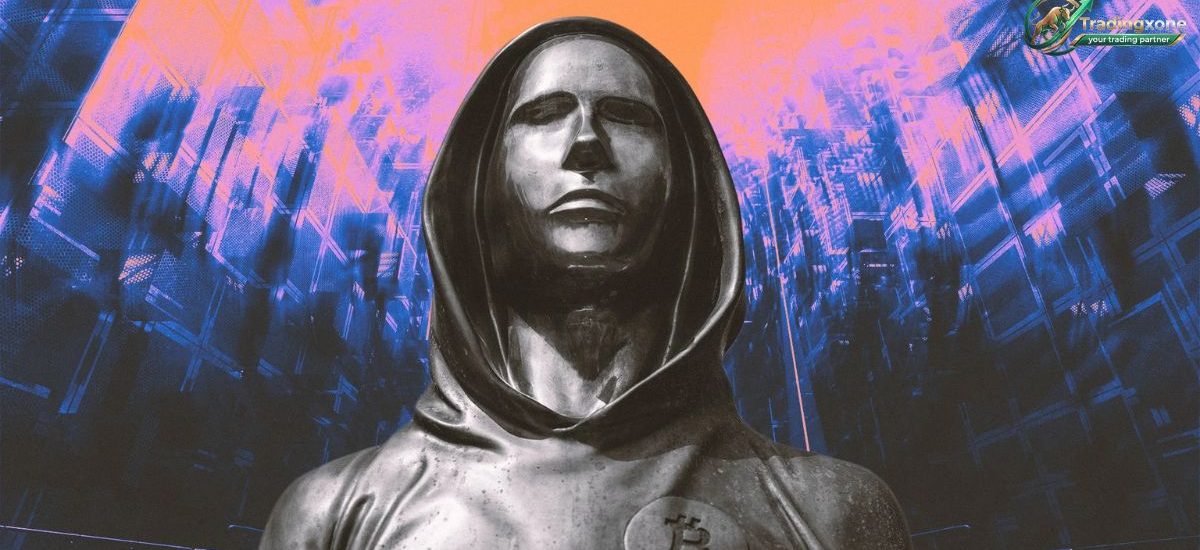
Somewhere in the world stands a bronze statue of a man whose face no person knows, whose real identity remains a mystery, and whose invention modified the worldwide financial and trading system all the time. The Satoshi Nakamoto statue is unlike anything that has ever been created earlier than. It pays tribute now not to a celeb, a politician, or a war hero, but to the unknown genius who invented Bitcoin and transformed modern trading and digital asset markets before suddenly disappearing. As Bitcoin adoption keeps to grow across the United States, discussions around how this invention influences modern trading markets and public art recognition are becoming louder than ever.
The statue was first unveiled in Budapest, Hungary, at Graphisoft Park, which serves as home to the Blockchain Budapest and Blockchain Hungary Association groups. The creators — an art collective that includes Gabi Debreczeni-Raskó, Debreczeni Barnabás, and Imre Szilágyi — designed the figure to have a reflective, mirror-like face.
This becomes a planned and deeply meaningful preference. Since no one knows who Satoshi Nakamoto is without a doubt, whilst you stand in front of the statue and consider Bitcoin’s effect on international buying and selling markets, you spot your personal reflection searching returned at you. In a very actual manner, the statue tells us that Satoshi may be everyone. It is a gesture blending art, finance, trading, and the philosophy of decentralization itself.
Who Is Satoshi Nakamoto?
The query of who invented Bitcoin is one of the most fascinating mysteries of modern-day technology. Satoshi Nakamoto is the choice used by the individual or enterprise company business agency who published the Bitcoin white paper in October 2008 and released the genesis block of the Bitcoin community on January 3, 2009. Satoshi additionally posted on the BitcoinTalk speak board, communicated through the P2P Foundation platform, and corresponded with early members via a cryptography mailing list. Then, in 2011, Satoshi handed over management of the Bitcoin open source implementation and vanished simply.
The identity of this figure has been the subject of immense speculation. Names like Nick Szabo, a computer scientist who pioneered the idea of smart contracts, and Hal Finney, the primary person besides Satoshi to run Bitcoin software, were floated as opportunities. Gavin Andresen, who took over the improvement of Bitcoin after Satoshi stepped away, has spoken publicly about the transition but has never confirmed Satoshi’s real identification.
Gabor Gurbacs, a well-known parent in the virtual asset industry, has also weighed in on the cultural significance of the thriller surrounding the inventor. Even though a high-profile HBO documentary tried to uncover the truth, the international community nonetheless does not recognize for sure who wrote the white paper that launched a completely new financial paradigm.
When people ask who invented Bitcoin, the sincere answer is: we don’t know for sure. What we do know is that this invention changed everything, and this is exactly why the Bitcoin community felt pressured to construct a statue in their honor. Satoshi Nakamoto’s net worth, if the founder truly holds the estimated one million Bitcoin often attributed to them, would make Satoshi one of the wealthiest people on Earth. At current prices, those Bitcoin holdings would place Satoshi’s fortune in the hundreds of billions of dollars — a fortune that has never been moved or spent.
You can also read about will bitcoin crash
From Budapest to the USA
The unique Satoshi Nakamoto statue sits at Graphisoft Park in Budapest, the same innovative campus that hosts the tech-targeted community activities prepared through the Blockchain Hungary Association and Kripto Akadémia. The statue was conceived as a homage to innovation and digital progress, and it speedy have become a pilgrimage site for contributors of the worldwide cryptocurrency network. Tourists, developers, investors, and curious visitors from around the world began making their way to Budapest just to stand in front of this shining, faceless figure and take in the meaning behind it.
But the Bitcoin community in the United States has been watching closely. The USA is home to some of the largest and most passionate Bitcoin communities in the world, and many voices in that community have called for a Satoshi statue on American soil. The us of a that brought on institutions like Goldman Sachs to take Bitcoin seriously as a topic of most important economic analysis, is likewise a country where public artwork celebrating technological pioneers has deep roots. From Silicon Valley to New York City, there are growing calls to carry a Satoshi statue to the United States to mark the profound impact that Bitcoin has had on American finance, culture, and era.
Art That Speaks to a Movement
The layout of the Satoshi Nakamoto artwork piece in Budapest is what makes it so effective. The art collective at the back of it did not try to place a face on an anonymous genius. Instead, they gave the figure an elegant surface in which a face might commonly be, turning each visitor into Satoshi Nakamoto for a moment.
The statue stands in a comfortable, however assured pose, sporting a hoodie — the uniform of the tech world — and invites every person who processes it to not forget their personal relationship with cash, era, and freedom.
The Satoshi Gallery idea has on the grounds that accelerated beyond the physical statue. Online and in network spaces, the concept of the Satoshi Gallery represents a broader cultural archive of Bitcoin’s history and significance.
The work has been praised in guides like The Defiant, a main media outlet focused on decentralized finance, and has drawn the attention of newshounds, teachers, and artists around the world. The statue isn’t just artwork — it is a cultural landmark that marks the instant when the sector began to reckon seriously with the concept that money could be reinvented.
Bitcoin Culture Is Rooted in the USA
To recognize why the concept of a Satoshi statue within the USA makes a lot experience, you have to recognize how deeply Bitcoin has penetrated American subculture. The cryptocurrency network in the United States is tremendous, passionate, and politically diverse. From libertarian tech employees in Austin, Texas, to Wall Street investors in New York who now manage Bitcoin funds, the impact of Satoshi’s invention is felt across every corner of American lifestyles.
Events celebrating Bitcoin, meetings devoted to exploring its future, and a growing variety of groups accepting Bitcoin as payment are all part of a thriving movement that appears to have Satoshi Nakamoto as its founding spirit.
The story of Bitcoin is also deeply tied to the spirit of grassroots innovation that Americans love. The genesis block — the first actual block ever mined on the Bitcoin community — contained a message referencing a newspaper headline about bank bailouts.
It became an assertion of financial freedom, distrust of centralized institutions, and the desire to build something new. That spirit resonates deeply in the USA, wherein the ideals of character sovereignty and financial independence are relevant to the country-wide identification.
El Salvador Showed the World What a Bitcoin Monument Means
Before the US could absolutely embrace the idea of a Satoshi statue, the arena was given a preview of what it means to honor Bitcoin as a national symbol. Under President Nayib Bukele, El Salvador has become the first United States of america inside the United States to adopt Bitcoin as criminal smooth. In El Zonte, the coastal community famously known as Bitcoin Beach, Bitcoin had already been used by citizens for a long term earlier than the government took action. The community there built something more than just an economy — they built a movement, and that movement inspired the wider Bitcoin network to think about physical monuments and cultural recognition in new ways.
That transformation also influenced global trading communities like Trading Xone, where Bitcoin is not only analyzed as a market asset but discussed as a historic shift in how nations and individuals think about money, sovereignty, and financial independence.
When the Plan ₿ Forum was held in Switzerland in reference to Swiss National Day, speakers and attendees from around the arena accumulated to speak about Bitcoin’s growing position in global society. The concept of public art celebrating Satoshi Nakamoto came up again and again, with members noting that the Budapest Satoshi statue had already come to be a cultural touchstone. Many argued that comparable monuments were needed in key cities around the world, including inside the United States — a reflection of how deeply Bitcoin has moved past an era and into a way of life, identity, and long-term financial vision.
What a USA Satoshi Statue Would Mean
The concept of setting a Satoshi Nakamoto statue in the USA is about more than art or tourism. It would be a statement. It could inform the arena that the USA takes Bitcoin seriously — no longer simply as a monetary tool, but as a cultural and technological revolution. A Satoshi statue in a city like Miami, which has positioned itself as a worldwide capital of Bitcoin, or in San Francisco, where the technology that made Bitcoin viable was born, or in New York City, where the international landscape is slowly being reshaped by means of digital property, would send a powerful message.
Cities and groups throughout the USA were actively debating the concept. Members of the Bitcoin network have mentioned that at the same time as statues of bankers, businessmen, and politicians line the streets of American cities, there may be no monument to the inventor of a generation that has created greater wealth for normal humans than almost any other innovation of the beyond decades. Even major financial institutions like BlackRock stepping into the Bitcoin space in recent years show how far this movement has come, from an obscure whitepaper to a globally recognized asset class.
Valentina Picozzi, a journalist and commentator who has included the cultural dimensions of Bitcoin, has stated that the absence of public art honoring Bitcoin’s origins says something crucial about how slowly establishments recognize authentic disruption.
The Mirror Face and What It Means for America
The most talked-about feature of the Satoshi Nakamoto statue is the reflective face, and within the context of the American way of life, this design preference takes on even deeper meaning. The United States is a country that prides itself on the idea that everyone can reap anything. The mirror face of the Satoshi statue speaks without delay to that belief. When you examine it, you notice yourself because of the ability to invent something global-changing. You see yourself as someone who could exchange the regulations of the game. In a rustic where the mythology of the self-made innovator is principal to the national story, the Satoshi statue is an excellent image.
The gesture blending art and technology that the Budapest art collective created is likewise specifically relevant to how Americans consider the relationship between creativity and innovation. Silicon Valley has long been visible as a place where artists and engineers speak the same language. The Satoshi statue brings that identical power to the world of finance and cash, asking us to look Bat itcoin no longer just as a commodity or an investment vehicle but as a form of cultural expression and a homage to innovation and virtual development that merits being celebrated in public spaces.
Beyond the Statue: Bitcoin’s Growing Footprint
While the talk about a Satoshi statue inside the USA continues, Bitcoin’s cultural footprint within the USA keeps developing. From developments that shape market sentiment and affect the BTC reward that miners receive, to creative experiments with tokenized cars, on-chain reservations at restaurants, and communities built around Shiba Inu and other digital assets, the world that Satoshi built has expanded far beyond what anyone could have imagined in 2009. The cryptocurrency network is not a small institution of cypherpunks passing messages on a cryptography mailing list. It is a global movement with tens of millions of members, billions of dollars in capital, and an increasingly vocal call for cultural recognition.
A Satoshi Nakamoto statue inside the USA would be one of the most significant ways to mark this moment in history.It would stand as a reminder of what one unknown person — or perhaps a small group of people — managed to do with nothing more than an idea, some code, and a white paper published on the internet. It would honor not just Satoshi, but all of us who believed in the vision early, who mined Bitcoin when no one could have conceived it would become really worth something, and who helped build the infrastructure that now underlies a trillion-dollar economic environment.
You can also read about mining bitcoins solo
The Legacy Belongs to Everyone
Satoshi Nakamoto never asked for credit. The anonymous nature of the invention was intentional. Unlike the founders of major corporations or the inventors of patented technologies, Satoshi gave Bitcoin to the world without a name attached, without a face, without a claim to the rewards. This is why the reflective statue is so perfect.
There is no face to put on the plaque, because the face is yours. The legacy belongs to the entire Bitcoin community, to every person who has ever bought, mined, or simply thought carefully about what it means to have money that no government can print into worthlessness.
As the Bitcoin network within the USA continues to develop, as greater agencies start accepting Bitcoin and greater establishments upload Bitcoin holdings to their balance sheets, the cultural recognition of Satoshi’s contribution will most effectively emerge as increasingly important. The Satoshi Nakamoto statue — whether or not it stands in Budapest or sooner or later in Miami, Austin, New York, or San Francisco — is a monument to the strength of a concept.
And in that experience, it already stands anywhere, within the minds of anybody who has ever held a Bitcoin and understood what it represents. The USA is ready for its own version of this tribute, and when it comes, it will stand as one of the most meaningful pieces of public art in the country’s history.
Conclusion
The Satoshi Nakamoto statue is greater than a sculpture of an unknown determinate — it’s far more an image of a concept that reshaped the worldwide monetary tool. By honoring the writer of Bitcoin, the statue recognizes no longer clearly someone, but a motion constructed on decentralization, freedom, and innovation. Its reflective face reminds us that Bitcoin no longer belongs to one founder, one u.S.A., or one organization. It belongs to anybody who believes in financial sovereignty and open generation.
As Bitcoin adoption continues to increase throughout the US, the communication around building a Satoshi statue on American soil feels increasingly more significant. Such a monument may not surely have a good time with the thriller of Satoshi’s identification; it is well known that the profound cultural, technological, and financial impact Bitcoin has had on cutting-edge society.
Whether in Budapest, Miami, New York, or Silicon Valley, the genuine legacy of Satoshi Nakamoto already lives on — in each block mined, every transaction validated, and every person who sees in Bitcoin the opportunity of an extra open economic destiny.
Frequently Asked Questions
Where is the authentic Satoshi Nakamoto statue positioned?
The original Satoshi Nakamoto statue is positioned in Graphisoft Park, Budapest, Hungary, and was unveiled in 2021 as a tribute to Bitcoin’s nameless writer.
Why does the Satoshi Nakamoto statue have a reflective face?
The reflective face symbolizes anonymity and decentralization, allowing visitors to see themselves as Satoshi and representing that Bitcoin belongs to anyone.
Who created the Satoshi Nakamoto statue?
The statue was created by way of Hungarian artists Gabi Debreczeni-Raskó, Debreczeni Barnabás, and Imre Szilágyi in collaboration with the nearby blockchain network.
Is there a Satoshi Nakamoto statue inside the United States?
Currently, there’s no respectable Satoshi statue within the USA, but discussions inside the Bitcoin network recommend a robust hobby in constructing one in cities like Miami or New York